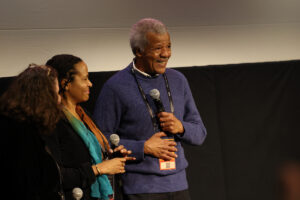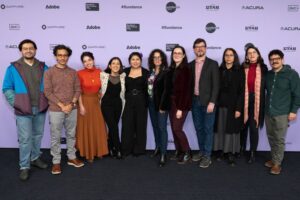




Andrew Ahn’s ‘Spa Night,’ a film that premiered at the 2016 Sundance Film Festival.
Nate von Zumwalt
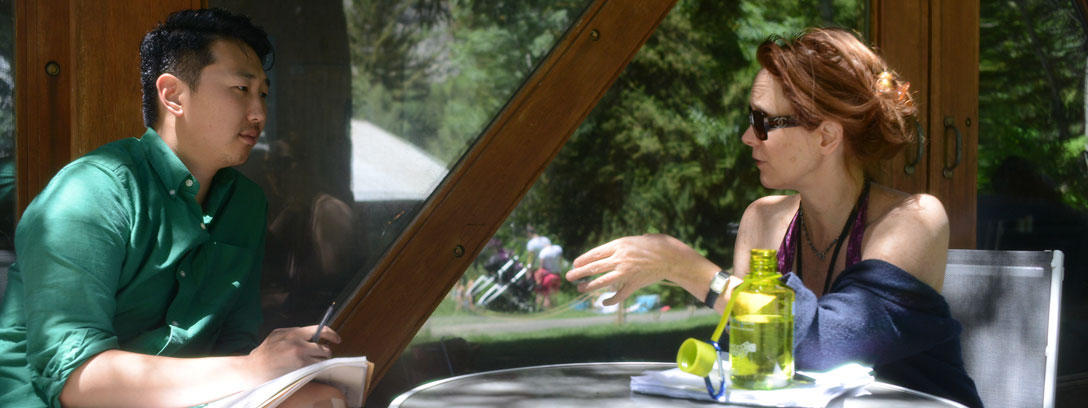
After bringing his short Dol (First Birthday) to the 2012 Sundance Film Festival, Andrew Ahn returns with Spa Night, in which he sheds light on the recondite world of the Korean-American gay community. Ahn’s protagonist, a closeted Korean American teen, takes a job at a Korean spa, where he discovers a simultaneously terrifying and titillating world of underground sex. From there, he’s forced to starkly confront what it means to be gay and Korean American. We recently sat down with Ahn to talk about the project and what it means to him.
Spa Night doesn’t appear expressly autobiographical, but it is strongly informed by your own experiences. Is that a fair interpretation?
That is a very fair interpretation! Spa Night may not be autobiographical, but it’s still very personal. My main character David feels like he could be a cousin of mine—someone that lives in the same community, breathes the same air as me. David is an amalgamation of different people that I know, of different experiences I have had. David and I are very different people, but I feel like we’re emotionally linked. I think it’s impossible to create a story, place, or character from scratch. It always comes from some personal experience or at least interest. Spa Night is not my life, but it could have been.
You’ve described Spa Night as a film that explores what it means to be gay and Korean American. In regard to the duality of that existence, what does it mean to inhabit both of those worlds?
As a second-generation Korean American, my connection to my Korean identity is almost entirely defined by my family. If I lived in Korea, my Korean identity would be informed by many other things: my citizenship, my language, my pop culture, etc. But because I’m Korean American, I mainly feel Korean because I have a Korean mother and a Korean father.
So what happens if I don’t have a Korean wife and don’t have a Korean child? Suddenly, my Korean identity is at stake because my homosexuality keeps me from duplicating that family structure. In this way, my two identities feel at odds with each other.
This is why I’m so thankful for the LGBTQ+ Korean American community. We can define our Korean identities and our queer identities through each other. In Spa Night, David hasn’t quite figured this out, but he gets one step closer.
Because this is such a uniquely personal story, how do you envisage viewers outside of either the Korean American or gay community connecting with the narrative?
At its core, Spa Night is about growing up. It’s about becoming your own person. At the beginning of the film, David is attracted to men—he has these desires, but he isn’t ready to make it an identity, to make it a part of himself. By the end of the film, David gets it. He grows up.
I think everyone understands that journey. We all grow up with different expectations of our futures that come from outside sources: family, community, society. But there’s always a moment when you can finally hear yourself above the noise, telling you what you really want. This is the moment that Spa Night explores.
I’m also excited to share a slice of Korean American culture with people who many not be so familiar with it. A lot of people have done Korean barbecue, but have they gone to a Korean spa? A Korean church? An Asian American frat party? This is a peek into a world that people know exists but haven’t ventured into. I think it should be really fun and eye-opening.
Which filmmakers do you count as having inspired or fueled your passion for film?
I love filmmakers who can capture a sense of humanity in their work. The Dardenne brothers and John Cassavetes are huge, huge inspirations. There’s something about their filmmaking that feels so alive—so slippery. It’s so thrilling to watch.
And then there’s Ozu. I love Yasujiro Ozu so much. I think Late Spring is the most beautiful film ever made. Each character, each place, each moment is given so much respect. Late Spring is so open-hearted. It doesn’t try and hide anything. There’s no crazy twist. It’s just honest.
That’s something I’m trying to do with Spa Night. I want to be an honest filmmaker. Earlier drafts of the screenplay actually took place entirely in the spa. It was cool but a little gimmicky. I realized I was hiding a very compelling part of the story—David’s family. And I was hiding it because that’s the most difficult, the most emotional part. As soon as I started the next draft, the whole film clicked for me.
One of the greatest tools Kickstarter offers are the pledge rewards. Yours are as thoughtful and hilarious as any—how many personalized karaoke thank you songs do you have in you?
I’ll sing every song in the karaoke books, if it that’s what it takes to reach my Kickstarter goal! “Bohemian Rhapsody,” “Don’t Stop Believin’,” Lisa Loeb’s “Stay”—whatever it is, I’ll do it. Also, I’m Korean. There’s no such thing as too much karaoke.